News
In our last blog post we dove into the mobility and aerospace sector as part of our continuing series introducing each of six evolute core sectors. If you have not had a chance to read all of them please take a minute to do so here. This week will be dedicated to something that impacts us all, the health and life sciences sector. The deep dive will be done by giving a brief overview of the sector supported by market data and a discussion of some of the booming sub verticals.
Definition of Health and Life Sciences
The health and life sciences sector comprises technologies that enhance how we diagnose, treat, and understand disease, offering solutions across the entire spectrum of care. This sector includes a diverse range of advancements such as gene-editing platforms like CRISPR, AI-driven drug-discovery engines, wearable biosensors for continuous health monitoring, lab-grown tissues and organs, and highly targeted biologic therapeutics.
Beyond direct treatment, these innovations enable smarter, more connected healthcare ecosystems reshaping everything from diagnostics to delivery, and even prevention with the increasing research into longevity treatments. Regenerative-medicine breakthroughs, telemedicine networks, real-time biosensing diagnostics, powerful bioinformatics pipelines, synthetic-biology toolkits, and next-generation imaging technologies for early disease detection are all propelling the industry toward a more personalized, healthier world.
Health and Life Sciences 2024 Performance
With an aging population and increasing rates of terminal and degenerative diseases worldwide, innovation in this sector cannot come quick enough! Compared to 2023 deal volume and total capital raised stayed consistent across all 4 quarters with $8.5 billion raised in 2024. However, growth was seen in the M&A space with a 10% increase in total capital spent accounting for $2 billion of the $8.5 billion; representative of a space still dominated by large pharmaceutical companies with money to spend on new innovations. Breaking down by deal stage, approximately 19% were classified as seed, 13% as early stage, 32% were classified as later stage, 4% classified as merger/acquisition, with the remaining being grants, refinancing, or other. The proportionally low number of m&a deals despite this deal type seeing the most YoY growth is representative of a few things. Firstly, of the large number of multi-billion dollar m&a deals (~20 completed above $1bn), and secondly of the lack of middle funnel activity in the VC space. The majority of VC deals occurred well below the $100m threshold which, given the capital intensive nature of this space, could be representative of the boom in new ideas which are ultimately bought up before many can reach the markers investors look for in the Series B plus stages.
2025 Outlook
Some key segments to watch in the second half of 2025 include AI-powered drug discovery, longevity tech, exoskeletons and prosthetics, and neurotechnology. These spaces have reported H1 metrics higher than last year in deal volume, total capital invested, and average age of companies. Proving market validation and hopefully strengthening the later stages and leading to continued m&a activity.
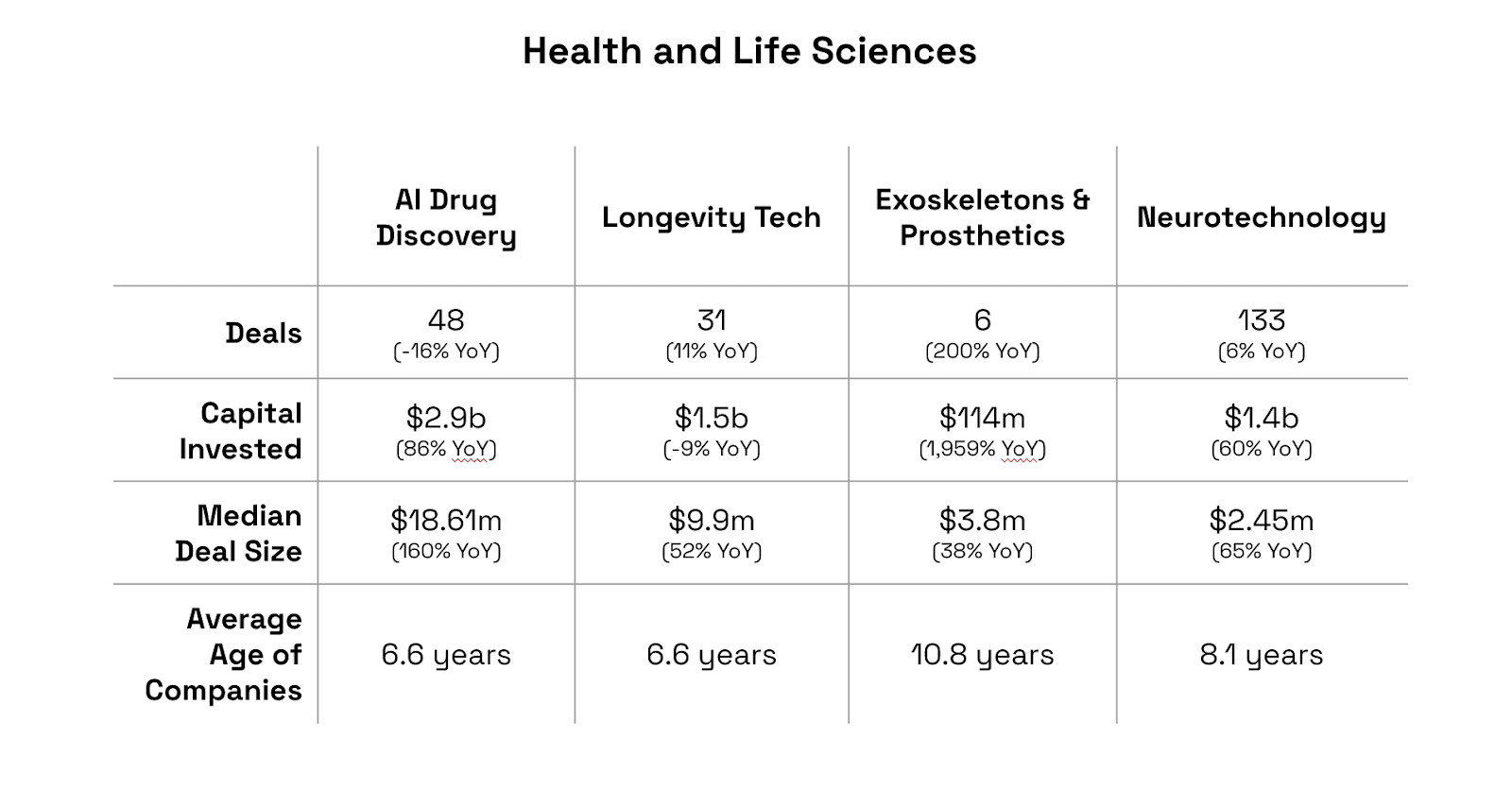
Source: Pitchbook
Conclusion
The health and life science sector is becoming the utmost of importance given the growing global demand of a sicker, aging population. As we monitor these evolving sub-verticals, it is clear that this space will continue to grow. In fact, its long-term prognosis is so healthy that even our spreadsheets are asking for a wellness check-up.
*All data used in this report is sourced from Pitchbook. Interested in our methodology? We will soon publish our State of Deep Tech in Europe 2024 Report which dives deeper into each section and outlines how we conducted our research.