News
In our last blog post, we dove into the health and life sciences sector as part of our continuing series introducing each of six evolute core sectors. If you have not had a chance to read all of them, please take a minute to do so here. This week will be dedicated to the advanced materials and manufacturing sector. The deep dive will be done by giving a brief overview of the sector supported by market data and a discussion of some of the booming sub-verticals.
Definition of Advanced Materials & Manufacturing
The advanced materials and manufacturing sector comprises technologies innovating how we design, produce, and deploy tangible products, offering solutions across a wide range of industries. This sector includes a diverse range of advancements such as 3D printing, research and application in nanomaterials, advanced composites for lightweight strength, photonics for precision applications, and robotics.
Beyond traditional manufacturing, these innovations enable smarter, more sustainable production ecosystems, reshaping everything from material selection to delivery. Autonomous manufacturing processes, AI-driven optimization engines, collaborative robotics for flexible production, high-performance alloys for critical applications, smart materials with adaptive properties, and circular manufacturing strategies are all major innovators in this industry.
Advanced Materials & Manufacturing 2024 Performance
As demand in key industries like housing and e-commerce continues to rise, the need for creative solutions within this vertical is becoming of increasing importance. Compared to 2023, deal volume in 2024 was down 12% YoY for a total of 1593 recorded deals. Total capital raised was also down with m&a and VC investors, likely the result of fewer deals, but also attributable to smaller deals in 2024, with the median deal size slightly down as well to $1.2m. This data is on par with the past few years where investor interest in this space has continued to slowly wane. When adjusting for outliers, this space saw an average deal size of $2m. Breaking down by deal stage, 24% were classified as seed, 17% as early-stage VC, 24% as later-stage VC, and 6% classified as m&a, with the rest being grants, refinancing, or other. Despite m&a deals making up significantly less proportionally than VC funding deals when it came to the size of the deals, mega acquisitions were the highlight of the year, with Nakamura Jidoki and Sign Essentials both being above $2.5b. Unlike other sectors we have explored, advanced manufacturing has one of the highest percentage of later-stage deals, ultimately reflecting investor confidence in the ability of these scale-ups to continue growing.
2025 Outlook
Despite the cold shoulder this sector is experiencing from investors, there are several niche spaces within the sector to watch in the second half of 2025 include carbon nanotubes, industrial workplace safety, mining tech, and deep-sea mining. These spaces have reported H1 metrics higher than last year in deal volume, total capital invested, and average age of companies. Proving market validation and hopefully strengthening the later stages and leading to continued m&a activity.
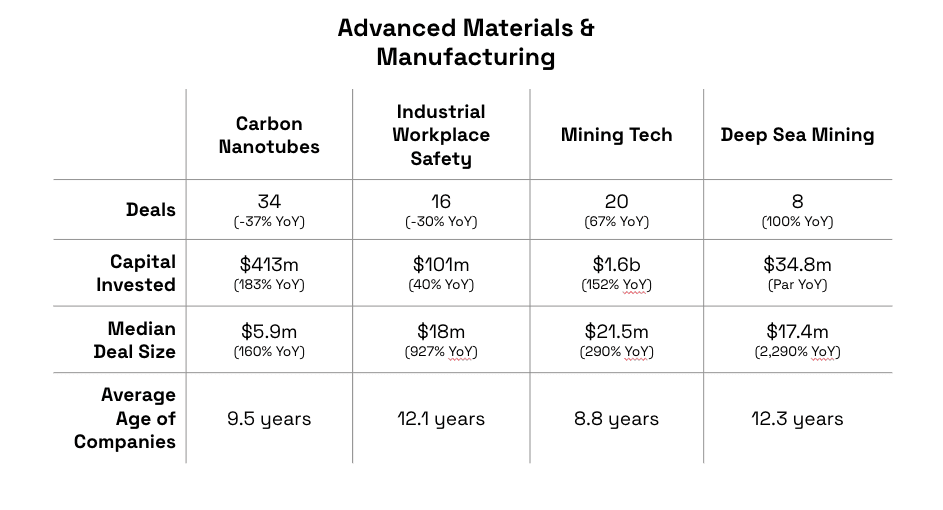
Source: Pitchbook
Conclusion
The advanced material and manufacturing sector is extremely important to the supply chain and B2B backbone of the global economy. As we continue to monitor these evolving sub-verticals, it is clear that this space will continue to innovate.
*All data used in this report is sourced from Pitchbook. Interested in our methodology? We will soon publish our State of Deep Tech in Europe 2024 Report which dives deeper into each section and outlines how we conducted our research.