News
In our last blog post, we dove into the advanced materials and manufacturing sector as part of our continuing series introducing each of six evolute core sectors. If you have not had a chance to read all of them, please take a minute to do so here. This week will be dedicated to the final sector, food and agriculture. The deep dive will be done by giving a brief overview of the sector supported by market data and a discussion of some of the booming sub-verticals.
Definition of Food & Agriculture
The food and agriculture sector comprises technologies that transform the food industry, from the labs, to the farms, and our kitchen tables, offering solutions to improve sustainability, resilience, and nutrition across the food chain. This sector includes a diverse range of advancements such as precision agriculture with drone-assisted crop management, IoT sensors for monitoring livestock health, cultured meat production for alternative proteins, autonomous harvesters and smart tractors for mechanized farming, and insect-based feed as a sustainable alternative for livestock nutrition.
Beyond food production, these innovations enable smarter agricultural systems that change everything from waste management to energy use. Waste upcycling into valuable resources, edible packaging to reduce plastic waste, smart greenhouses with climate-optimized environments, vertical farming for urban food security, and biofuel production from agricultural residues.
Food & Agriculture 2024 Performance
As the global population inches closer to the 9 billion mark, we will need to devote considerable resources to growing food and coming up with creative ways to sustainably extract more output from shrinking space. Compared to 2023, deal volume in 2024 was on par YoY with 187 deals recorded, and an average deal size (outlier adjusted) of $2.1m. Total capital raised was also on par. Breaking down by deal stage, 20% were classified as seed, 14% early-stage VC, 28% as later-stage VC, and 2% as m&a, with the rest being grants, refinancing, or other. This distribution suggests that while investor interest remains steady, there is a notable focus on later-stage ventures, indicating a maturing market, stepping away from experimental startups like meat alternatives and a focus on scaling proven technologies.
2025 Outlook
Some key segments to watch in the second half of 2025 include livestock health, indoor farming, cellular agriculture, and insect-based foods. These spaces have been particularly satisfying investor appetite in 2025 as they have reported H1 metrics higher than last year in deal volume, total capital invested, and average age of companies. Proving market validation and hopefully strengthening the later stages and leading to continued m&a activity.
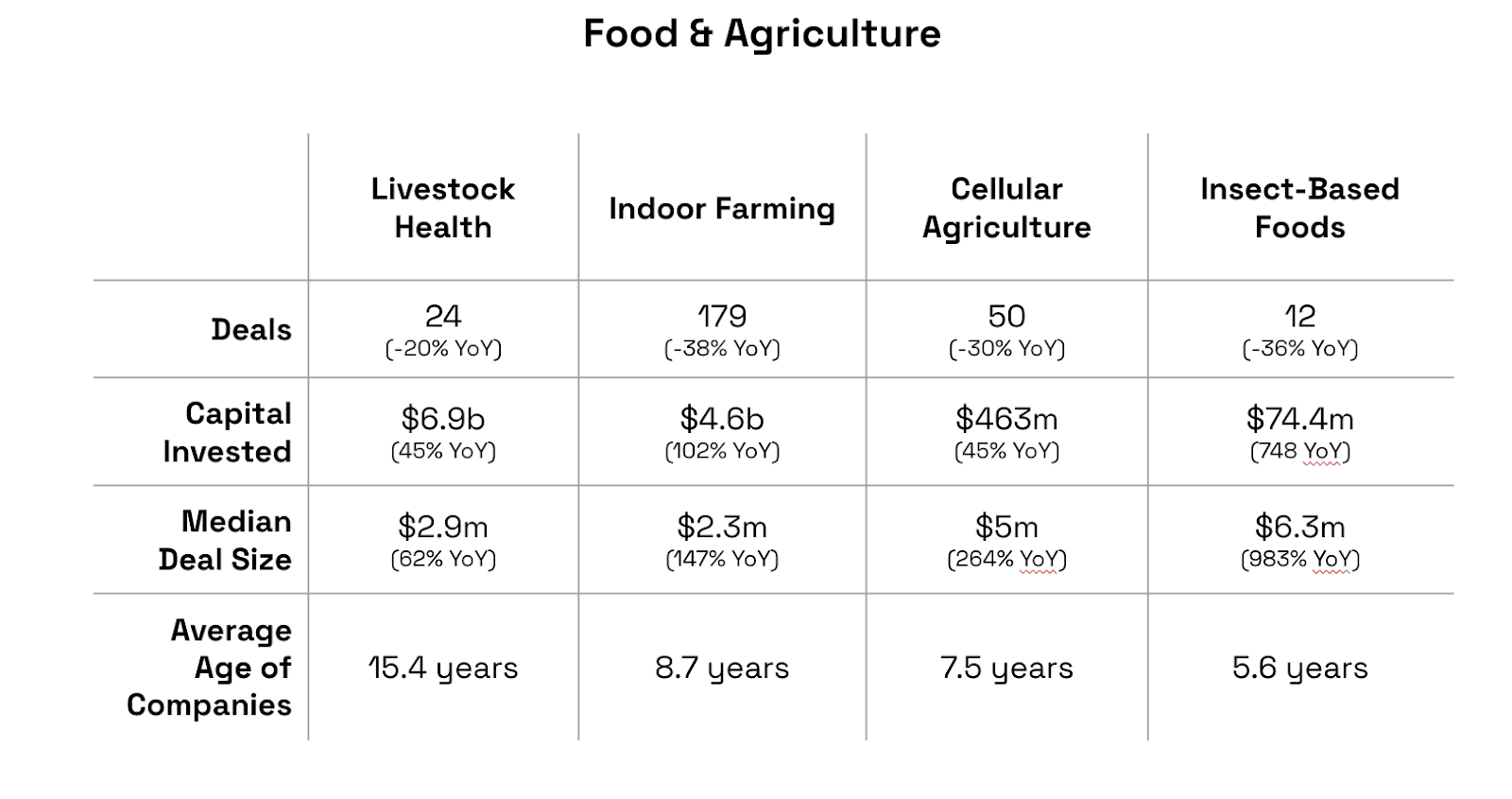
Source: Pitchbook
Conclusion
The food and agriculture sector is arguably the most important sector for our everyday lives. As we continue to monitor these sub-verticals, it is clear that this space will continue to grow, quite literally, and keep sprouting new innovations that feed both people and the planet!
*All data used in this report is sourced from Pitchbook. Interested in our methodology? We will soon publish our State of Deep Tech in Europe 2024 Report which dives deeper into each section and outlines how we conducted our research.