News
As mentioned in our most recent blog post (which can be read here), the following weeks will be dedicated to exploring each of the Evolute “sectors of deeptech.” In the previous blog, we defined what deep tech is, a fluid term used to categorize startups based on novel scientific discovery and significant scientific research. Since this term encompasses a wide umbrella of companies, further segmentation of the key industries active within deep tech allows for a better understanding. For the first week, we have chosen to dive into the Digital Technology sector and done so by giving a brief overview of the sector supported by market data and a discussion of some of the booming sub-verticals.
Definition of Digital Technology
The digital technology sector encompasses a broad spectrum of innovations, focusing on software applications across various industries. While not necessarily focusing on hardware, there are situations where overlap occurs, which is important to recognize, such as in spaces like quantum computing. Key examples include artificial intelligence (AI), which drives automation and enables predictive analytics to improve efficiency and decision-making; quantum computing, which shows potential in solving complex optimization problems beyond the capacity of traditional computing; cloud infrastructure, with on-demand data processing and storage, and cybersecurity, tools that offer critical capabilities in detecting and responding to digital threats.
These technologies are enhancing existing systems and creating new functionalities. Photonics, for example, supports high-speed data transmission and precise marking applications. Sensors embedded in devices and environments enable real-time monitoring, supporting uses from industrial automation to environmental analysis. Meanwhile, smart infrastructure—integrating data, automation, and connectivity—facilitates more efficient urban planning, energy usage, and mobility management.
Collectively, these innovations are transforming digital and physical systems. They expand operational capabilities, optimize resource use, and open new pathways for growth and sustainability. As digital technology continues to evolve, it remains a foundational driver of change across sectors.
Digital Technology 2024 Performance
Digital Technology is arguably the largest sector when looking at overall funding. In 2024, EU deep tech investments surpassed 20% of all EU VC funding. Digital technology mega deals played a significant role in boosting the proportion of deep tech funding with deals like Wayve’s $960m round or Mistral AI raising $1b. Looking beyond the EU and ignoring the outliers, this sector still saw strong growth in all stages of funding. In 2024 alone, just over 2600 venture and m&a deals were recorded, accounting for $24.4 billion worth of deep tech investment and almost 17,000 investors. All stages of the VC funnel had strong activity, with the majority of all deals being under $10m, where average deal size (excluding outliers) was $1.63 million. When breaking down by stage, 30% were seed rounds, 16% were early-stage VC, 18% were late-stage VC, and the rest were classified as m&a, refinancing, or other.
2025 Outlook
Some key spaces to watch in the second half of 2025 include LLM agents, quantum sensing, high-performance/quantum computing, and photonics. These spaces have reported H1 metrics higher than last year in deal volume, total capital invested, and average age of companies, proving market validation and strengthening the later-stage pipelines.
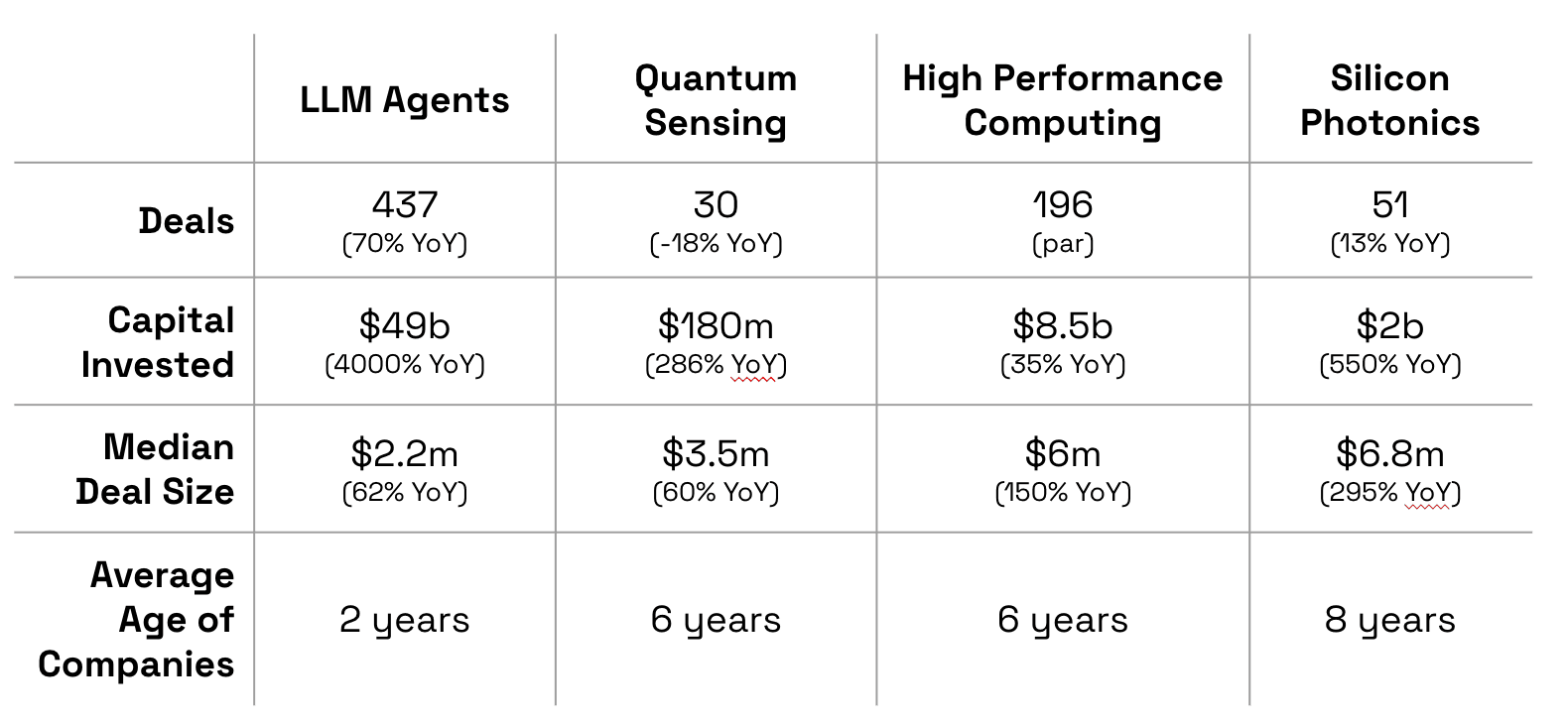
Source: Pitchbook
Conclusion
The digital technology sector remains a cornerstone of the deep tech landscape, underpinning innovation across industries through continued investment and technological breakthroughs. As we monitor these evolving sub-verticals, it’s clear that digital tech will continue to drive market momentum and shape the future of deep tech.
*All data used in this report is sourced from Pitchbook. Interested in our methodology? We will soon publish our State of Deep Tech in Europe 2024 Report which dives deeper into each section and outlines how we conducted our research.